
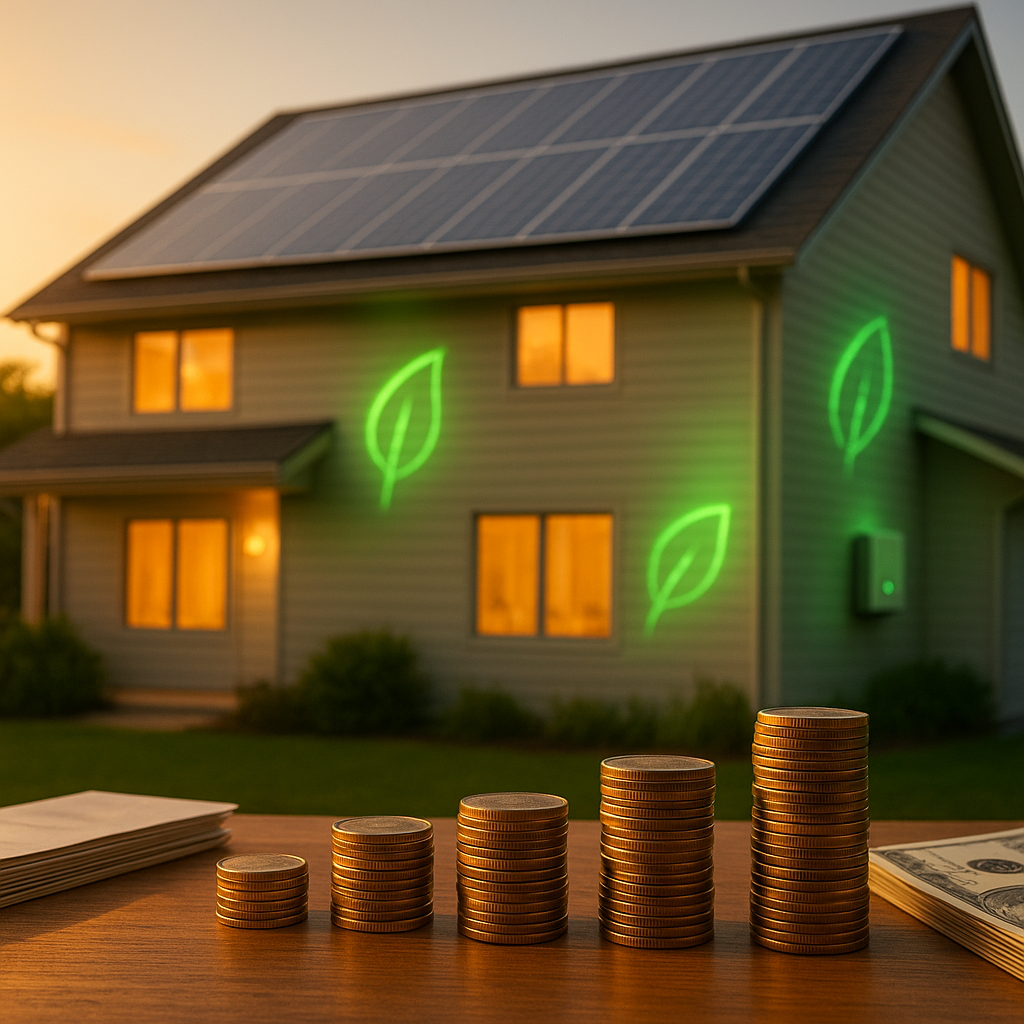
Making your home more energy efficient has never been more financially rewarding. Beyond the obvious reduction in monthly utility bills, homeowners in the United States can tap into a surprisingly generous range of tax credits, financing options, and long-term savings that make energy efficient upgrades genuinely worth considering from a purely financial standpoint. Whether you’re thinking about new insulation, a heat pump, or solar panels, understanding the financial landscape before you start is essential to getting the most out of every pound — or in this case, every dollar — you invest.
This guide breaks down the real financial benefits of energy efficient home improvements, from federal tax credits to financing strategies and resale value, so you can approach any project with your eyes wide open.
Understanding the Energy Efficient Home Improvement Credit
One of the most significant financial tools available to homeowners right now is the Energy Efficient Home Improvement Credit, sometimes referred to as the 25C credit. Thanks to the Inflation Reduction Act of 2022, this credit was substantially expanded and extended, giving homeowners a far better deal than previous iterations of the programme.
Under the current rules, homeowners can claim a tax credit worth 30% of the cost of qualifying improvements, up to certain annual limits. This is not a deduction — it’s a direct reduction in the tax you owe, which makes it considerably more valuable. The credit applies to a broad range of upgrades, including:
- Heat pumps and heat pump water heaters
- Central air conditioning systems
- Insulation and air sealing materials
- Energy efficient windows and skylights
- Exterior doors
- Electrical panel upgrades (where required to support qualifying improvements)
- Home energy audits
The annual cap for most improvements is $1,200 per year, with a separate, higher cap of $2,000 for heat pumps and heat pump water heaters. Importantly, because the credit resets each tax year, a homeowner who spreads their improvements across multiple years can claim far more in total than if they completed everything at once. For example, someone who installs new windows one year and a heat pump the next could claim up to $3,200 across those two years alone.
What Energy Efficient Home Improvements Are Tax Deductible?
This is a question that causes a fair amount of confusion, and it’s worth clarifying the distinction between tax credits and tax deductions. Most energy efficient home improvements qualify for tax credits rather than deductions. A tax credit directly reduces your tax bill dollar-for-dollar, whereas a deduction only reduces your taxable income, which is generally less valuable.
For the majority of homeowners, the relevant benefit comes through the Energy Efficient Home Improvement Credit (25C) and the Residential Clean Energy Credit (25D), not through deductions. However, if you operate a home-based business or rent out part of your property, a portion of your energy improvement costs may be deductible as a business expense — though this situation requires careful record-keeping and ideally professional tax guidance.
What Home Improvements Can You Claim on Taxes?
Under the 25C credit, qualifying improvements must meet specific energy efficiency standards, often defined by ENERGY STAR certification or standards set by the Consortium for Energy Efficiency. Broadly speaking, the types of improvements that qualify include:
- Insulation: Bulk insulation products and air sealing materials qualify, provided they are expected to last at least two years and are installed in line with current standards.
- Windows and doors: ENERGY STAR-certified windows and skylights, and exterior doors that meet Energy Star Most Efficient criteria, are included.
- HVAC systems: Qualifying heat pumps, central air conditioners, furnaces, and boilers are covered.
- Water heaters: Heat pump water heaters and gas, propane, or oil water heaters that meet efficiency thresholds qualify.
- Home energy audits: A credit of up to $150 is available for a professional home energy audit.
It is worth noting that general home improvements — such as kitchen renovations, bathroom remodels, or decorative changes — do not qualify, even if they happen to reduce energy use as a side effect.
The Residential Clean Energy Credit Explained
Separate from the home improvement credit is the Residential Clean Energy Credit (25D), which covers larger-scale renewable energy installations. This credit is worth 30% of the cost of qualifying systems with no annual dollar cap, making it particularly valuable for homeowners investing in:
- Solar electric (photovoltaic) panels
- Solar water heaters
- Small wind turbines
- Geothermal heat pumps
- Battery storage systems (from 2023 onwards)
- Fuel cell systems
A homeowner who installs a solar panel system costing $20,000, for instance, could receive a federal tax credit of $6,000. If the credit exceeds the tax owed in one year, the remainder can be carried forward to future tax years, meaning it is not lost even if the homeowner doesn’t owe enough tax in that particular year to absorb the full amount.

How Does the New $6,000 Tax Deduction Work?
There has been some discussion online about a “$6,000 tax deduction” in relation to energy improvements. This most likely refers to the potential value of the Residential Clean Energy Credit on a system costing around $20,000, since 30% of that amount equals $6,000. It could also refer to various state-level incentives or newer legislative proposals. It is important to verify the specific credit or incentive being referenced, as tax legislation does evolve — particularly with ongoing discussions around the “Big Beautiful Bill” and potential changes to energy-related credits from 2025 onwards.
For the most accurate and up-to-date information, the IRS website (irs.gov) and ENERGY STAR’s resources (energystar.gov) are the authoritative sources.
Can You Get Money Back on Taxes for Home Improvement?
This is one of the most commonly asked questions, and the answer depends on how the credit interacts with your personal tax situation. The Energy Efficient Home Improvement Credit (25C) is a non-refundable credit, which means it can reduce your tax bill to zero but will not result in a refund beyond that point. If the credit amount exceeds what you owe in taxes, the excess is unfortunately not paid out as a refund, nor can it be carried forward to future years.
The Residential Clean Energy Credit (25D), on the other hand, does allow unused amounts to be carried forward to subsequent tax years, making it more flexible for homeowners who have a smaller tax liability in any given year.
In practical terms, homeowners with a moderate to higher tax liability will benefit the most from these credits. Those with very low tax bills may find they cannot fully utilise non-refundable credits in the year the improvements are made.
Financing Energy Efficient Home Improvements
Even with tax credits available, the upfront cost of energy efficient improvements can be a barrier. Fortunately, there are several financing options specifically designed for this purpose.
Energy Efficient Mortgages
An Energy Efficient Mortgage (EEM) allows borrowers to include the cost of energy improvements in their mortgage — either when purchasing a home or refinancing. Both FHA and conventional EEMs are available, and they can cover improvements such as insulation, HVAC upgrades, and even solar installations. The logic is straightforward: if energy savings will reduce monthly utility bills, those savings can effectively help service the additional mortgage debt.
Green Home Equity Loans and HELOCs
For existing homeowners, tapping into home equity via a home equity loan or home equity line of credit (HELOC) is a popular way to fund larger improvements. Some lenders offer preferential rates specifically for verified energy efficient projects. The interest paid on home equity loans used to substantially improve the home may also be tax-deductible in some circumstances, adding another layer of potential financial benefit.
PACE Financing
Property Assessed Clean Energy (PACE) financing is a unique mechanism available in several US states that allows homeowners to borrow money for energy improvements and repay the loan through an addition to their property tax bill. Repayment terms can be long — up to 25 years in some cases — and the loan typically transfers with the home if it is sold, which can be either an advantage or a complication depending on the circumstances.
Utility Company Rebates and Programmes
Before taking out any financing, it is worth checking with local utility companies, as many offer rebates, low-interest loans, or on-bill financing for efficiency upgrades. Some programmes will cover a significant portion of the cost of qualifying insulation, appliances, or smart thermostats. These rebates can often be stacked with federal tax credits, maximising total savings.
Long-Term Financial Benefits Beyond Tax Credits
Tax credits are immediate financial wins, but the ongoing benefits of energy efficient home improvements accumulate over time and can significantly affect overall financial wellbeing.
Reduced Energy Bills
The US Department of Energy estimates that proper insulation alone can reduce heating and cooling costs by up to 15%, while a heat pump can be two to three times more energy efficient than a conventional electric heating system. Over a decade, these savings can easily surpass the initial investment, particularly as energy prices continue to fluctuate.
Increased Property Value
Research consistently shows that energy efficient homes command higher sale prices. A study by the US Department of Energy found that homes with solar installations sold for an average premium of around $15,000 compared to non-solar homes. More broadly, buyers are increasingly aware of and willing to pay for lower ongoing utility costs, meaning efficiency upgrades can provide a meaningful return on investment when the time comes to sell.
Protection Against Rising Energy Costs
Energy prices are subject to significant volatility. Homeowners who invest in efficiency improvements effectively hedge against future price increases by reducing their overall energy consumption. The less energy a home requires, the less exposed its occupants are to fluctuations in gas and electricity prices — a financial benefit that becomes more valuable during periods of economic uncertainty.
Looking Ahead: Energy Efficient Home Improvement Credit in 2025 and 2026
The Energy Efficient Home Improvement Credit, as extended by the Inflation Reduction Act, is currently scheduled to remain in place through 2032. However, legislative developments — including proposals sometimes referred to under various budget bills — could affect the specifics of these credits. Homeowners considering improvements should stay informed about any changes to tax law and consider acting sooner rather than later to take advantage of credits as they currently stand.
State-level incentives also evolve regularly, and many states offer their own additional credits, rebates, or financing schemes that complement federal programmes. Checking with the Database of State Incentives for Renewables and Efficiency (dsireusa.org) provides a comprehensive overview of what is available in each state.
Key Takeaways
Energy efficient home improvements offer a genuinely compelling financial case that goes well beyond environmental considerations. From immediate tax credits to long-term savings on utility bills, increased property values, and access to specialised financing, the financial ecosystem supporting these upgrades is more robust than many homeowners realise.
Understanding the difference between refundable and non-refundable credits, knowing which improvements qualify under which programmes, and planning upgrades strategically across multiple tax years can meaningfully amplify the total financial benefit. Whether the goal is to reduce monthly outgoings, lower a tax bill, or increase a home’s resale value, energy efficiency improvements represent one of the more financially sound investments a homeowner can make in the current landscape.